Book the tickets
Booking hours:
9.00am-13.00pm
Monday- Friday
Reservations are accepted up to 3 months in advance of your arrival date
+48 33 823 35 65
+48 33 823 26 62
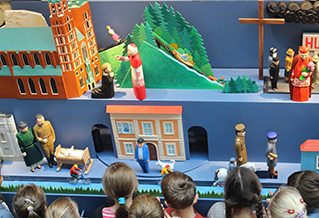
A wooden carriage, and the whole world on it, also wooden and moving world. Everything weighs 400 kg. It is a theater in the museum of John Paul II in Wadowice. There are several wooden figures representing the pope, from his infancy to old age.
„When assembling the theater, we were observed by children through the glass that closes the patio. They pressed their noses against the glass and tried to see what we were doing there. Every moving figure, which they saw, immediately aroused their smile” – says Barbara Kłaput from the „Kłaput Projekt” studio in Warsaw.
Together with her husband, Jarosław, they designed the Museum Family Home of John Paul II. This moving theater is a final stage of the transformation of this place (the transformation started with three rooms and ended with the entire building with basements and attic).
Modeled on those that were arriving in the city backyards in Karol Wojtyla’s childhood, a theater designed by Kłaput is much greater, because it has to tell the whole story of the Pope’s life.
They worked on it in a dozen or so team. First came the script, and then the so-called movement scenario (each figure follows the designated traffic route).
Modeled on those that were arriving in the city backyards in Karol Wojtyla’s childhood, a theater designed by Kłaput is much greater, because it has to tell the whole story of the Pope’s life.
They worked on it in a dozen or so team. First they did the script, and then the so-called movement scenario (each figure follows the designated traffic route).
One engine puts everything in motion
“It was the precision of a watchmaker. Everything had to be precise to the millimeter, otherwise it would lead to defects, noises. We wanted a very simple mechanism. One engine sets in motion all platforms and figurines, and moreover they are driven by chains, cogwheels and gears. We also assumed that most of the figures should move, to bring joy especially to children” – says the designer.
Therefore, the wooden horses move their hooves, the soldiers march, the angels fly, the bike goes around and the wooden Cardinal Sapieha blesses, raising his hand.
All the figures, and they are 60, are the works of Wojciech Zasadni, a sculptor from Warsaw who has been working for years with the „Kłaput Project”. He chose linden wood. He created more than a dozen figurines of Wojtyla, from the baby to the elderly and ailing Pope.
The history of Wojtyla in this wooden theater begins with the history of the twentieth century. The scenes of Wadowice before the war, the legionnaires of Piłsudski, the parents of Wojtyla appear on the platforms. You can swing the little Lolek in the cradle (children can turn the crank). Then, there is the time of adolescence and the war. After that, the priesthood and pastoral work with young people, in which the priest Karol had been involved. The theater begins this way: young people with backpacks go up the hill, there is also Wojtyła among them.
They descend by canoe. Another platform and we move to the time of his pontificate: it starts with the famous „Habemus Papam”, then the figure of John Paul II roams around the world. When we arrive at the time of the assassination attempt, there appears a big gun. The last scene is the one in which the angels take the pope to the sky.
In Blue
As Kłaput say, bright colors (blue dominates) and simplifications of the scenario have been applied to keep the ludic atmosphere of the theater. This atmosphere is emphasized by music: transformed with a barrel organ „Góralu, czy nie żal”. This is a poem from prison created in the second half of the nineteenth century by Michall Bałucki, detained in „Saint Michael” in Krakow (today this is the building of the Archaeological Museum). His fellow prisoner was a Goral (Polish Highlander) accused of inciting, who missed his homeland very much. For him, Michał Bałucki has created a poem which later was transformed into a song. The Polish Highlanders willingly sang this song to the pope.
It is a remarkable experience to see the reactions of the children watching the theater. They understand this simple visual message. It can be seen by observing the children, when they watch what happens on the mobile platforms with gaping mouths and the curiosity – says Barbara Kłaput.
The source:
m.krakow.gazeta.pl
